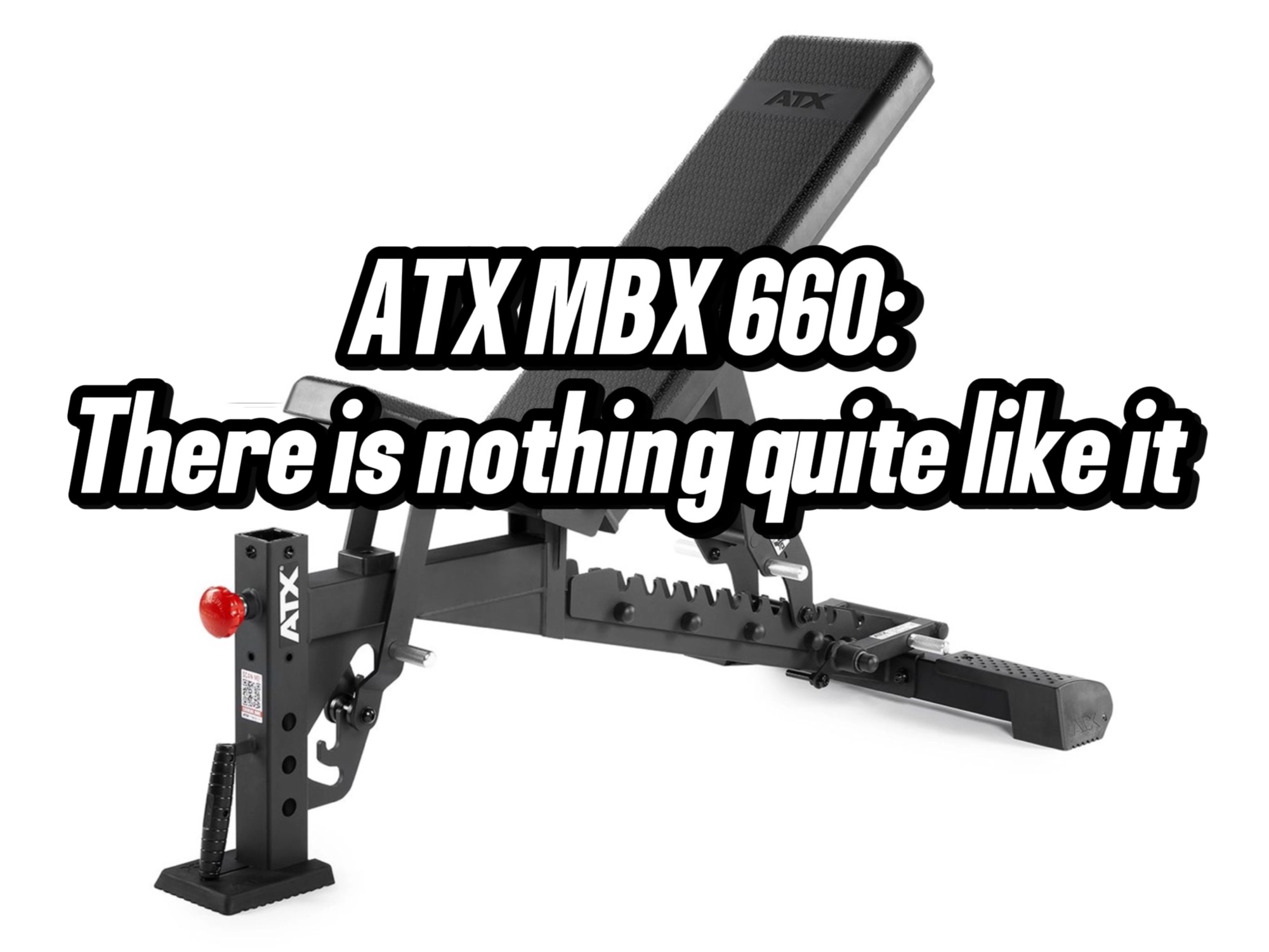
The ATX MBX 660 PU is the most affordable and versatile bench in the very limited field of three-footed and true heavy-duty FID (flat, incline, decline) benches that can use attachments.
Specs
- Price: 560 Euro
- Adjustments: 14-way adjustable backrest with decline, flat and incline. 4-way adjustable seat
- Load capacity: 500 kilos
- Unit weight: 43 kilos
- Unit L x W x H: 1376 x 684 x 440 millimeters
- Pad L x W: 1190 x 260 millimeters
- Padding options: Standard or grippy polyurethane padding
- Colour options: Black
Build Quality
The ATX MBX 660 boasts an enormously heavy-duty construction. Its solid frame does not move during any exercises. This stability is especially valuable when you start adding attachment to the bench. The obvious trade-off is that it is pretty heavy to move around. But, the wheels and front handle greatly attenuate this.
The bench has several premium features. All pieces that lock into place are plastic coated. This provides some much appreciated noise dampening when adjusting the bench. The small adjustment handles spread throughout are all chromed and knurled. And the increments for the backrest are laser cut into the frame. Finally, the pad dimensions and its height of the ground conforms to the IPF standard. Hence, you are not floating above ground as is often the case on many cheap adjustable benches.

Notice: The pop-pins are covered in black plastic. They are NOT red as shown on many distributers’ websites. 
Notice: The pop-pins are covered in black plastic. They are NOT red as shown on many distributers’ websites. 
Notice: The pop-pins are covered in black plastic. They are NOT red as shown on many distributers’ websites. 
Notice: The pop-pins are covered in black plastic. They are NOT red as shown on many distributers’ websites. 
Notice: The pop-pins are covered in black plastic. They are NOT red as shown on many distributers’ websites.
The assembly was surprisingly simple. The bench almost came fully assembled on a crate. I only had to mount the two pads and the rear feet. My bench arrived with some broken minor parts that seemed to have been damaged during transport. I reached out to ATX, and they answered within 30 minutes and sent me replacement parts without any hesitation. And most of these broken parts, were some of the protective plastic pieces that are all over this bench. So they did exactly what they were supposed to.
Functionality
The standout feature of the ATX MBX 660 is that it is a true three-footed heavy duty FID bench that offers the use of attachments. And from my experience with the ATX leg extension attachment, ATX is investing a lot of effort into these attachments. They did not even stop at one attachment point. They made one for each end of the bench. This enables the bench to be extremely versatile in a home gym setting – while also being able to grow with your needs.

Lazer cutouts to show the angles on the backrest. 
Regular pad (left). PU pad (right) 
I think a vertical handle on a bench of this size and weight is superior compared to a horizontal one. 
Wheels and plastic covers on hind legs. 
Protective plastic where parts interact. 
More protective plastic where parts interact. 
Even more protective plastive where parts interact.
We have come to expect a single front leg on high-end benches, and this bench is no exception. This feature may seem minimal at first glance. But is allows more room for the user’s feet when pressing their legs into the ground on bench press. And the low height of the the bench also contributes to this. Additionally, the three-footed design makes the bench more space saving when stored upright. The ability to be stored upright has also become an industry standard for high-end adjustable benches aimed at the home gym market.
The bench comes with either standard fake leather pads or a grippy PU (polyurethane) padding. The fake leather padding is comfortable yet stable. However, it is the PU padding that is interesting. It is very hard and not very comfortable. But, it provides SO much grip on your torso during benching. I actually managed to train shirtless during some sweaty sessions without being bothered by a slippery padding at all. Additionally, the PU padding is very easy to clean. And mine has yet to show any sign of those classic sweat spots that you see on fake leather padding.
Switching between different angles of incline and decline is super quick. But, switching from flat to either incline or decline isn’t as rapid as the competitors’ benches. This is because ATX has made a little safety lock, so the bench can’t collapse when stored upright. The additional safety is likely due to this bench being rated for commercial use. It rarely bothers me. However, when talking safety, I would add that the weight of this bench and the way you go from flat to incline/decline actually does put your fingers more in harms way than regular adjustable bench designs. ATX has tried to address this with stickers indicating pinch points.
Price & Value
First of. If you are considering this bench, odds are that you are pretty far into your home gym journey. You are looking for high-end equipment, and the price is somewhat secondary. This is not necessarily the first adjustable bench that newcomers should buy. Unless they are really sure that they are in it for the long run or they take benching very seriously. There are other much cheaper adjustable benches with cheaper attachments out there that people can then upgrade from later.
That being said. To my knowledge there are very few competitors when it comes to real heavy-duty commercial grade benches that feature attachments: Rogue Manta Ray (1250 euro), REP BlackWing (600 euro) and the Powertec Utility Bench (480 euro). And the Powertec bench is really not at the same level in regards to build quality and finish as the other three benches. So, at 560 euro the ATX MBX 660 is pretty competitively priced.
Conclusion
In summary, I think this is a bench that most people will buy as their second or third bench. And it will be their final bench. Both due to its quality and functionality. But perhaps as importantly due to its modularity and ability to grow with your needs. Especially, if ATX continues to expand on their line-up of high-quality attachments. Additionally, this bench heavily caters to people who are serious about benching.
But, if all my talk about grippy PU padding, heavy-duty commercial grade build quality, IPF-specs and three-legged design is unimportant to you. And you are just looking for a good adjustable bench with a ton of attachments possibilities, then you should definitely consider the Powertec Utility Bench. It is a step above the competition in the cheaper end. And to this date, they have the biggest catalog of bench attachments.
The only enhancements I would hope to see in the future are: 1) An option for a fat pad. 2) Some sort of lip for gripping the end of the backrest while adjusting from flat to incline/decline. 3) I would love if the pins for securing attachments were true pop-pin without any screwing mechanism. Lastly, I have yet to verify a very significant detail: Whether Powertec attachments are compatible with ATX Benches (to be continued).
Leave a Reply